



UN Women has warned that there is growing evidence that rape is being used “deliberately and systematically” in Sudan, stressing that women and girls “are not statistics, they are the measure of our shared humanity.”
UN Women released a report Tuesday focusing on the gendered dimensions of food insecurity in Sudan. Speaking to reporters in Geneva after the report’s release, Anna Motavati, UN Women’s Regional Director for East and Southern Africa, said that every day “the world delays taking action on Sudan, another woman gives birth under bombardment, buries her child from starvation, or disappears without justice.”
She said women reported suffering from hunger, displacement, rape, and bombing in El Fasher, “the heart of Sudan’s latest catastrophe,” where “pregnant women gave birth in the streets after the last remaining maternity hospitals were looted and destroyed.”
The Rapid Support Forces (RSF) seized El Fasher, the capital of North Darfur state, after a siege of more than 500 days in late October, amid reports of widespread atrocities, including summary executions and sexual violence. Ms. Mutafati said thousands of women and girls have fled the city due to the deteriorating situation, seeking refuge in other parts of North Darfur, including Tawila, about 70 kilometers away, Korma, and Mellit, where the humanitarian presence is “very limited.”
“What the women are telling us is that during their harrowing journeys, every step they took to fetch water, collect firewood, or stand in line for food carried a high risk of sexual violence,” she added.
Ms. Mutafati warned that women’s bodies “have become a crime scene in Sudan,” emphasizing that “there are no longer any safe places” where women can access protection or basic psychosocial support.
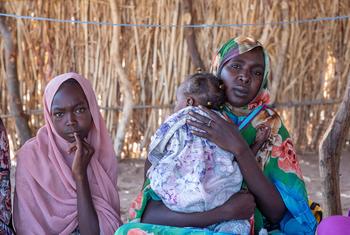
People who fled El Fasher arrive in Tawila, North Darfur, Sudan.
Mothers Go Hungry So Their Children Can Eat
The UN official said that “basic dignity has also collapsed,” explaining that a single pack of sanitary pads in North Darfur costs about $27, while the average humanitarian cash assistance is just under $150 a month for a family of six.
Ms. Mutafati spoke of “impossible decisions” made by families “forced to choose between food, medicine, and dignity,” emphasizing that the basic needs of women and girls “are at the bottom of that list.”
She said: “Most women and girls in Sudan may not eat at all. Women often skip meals so their children can eat, while adolescent girls often receive the smallest portion, undermining their long-term nutrition and health.”
Ms. Mutafati warned that the hunger women are experiencing has a “ripple effect,” as health workers report an increase in cases of severe acute malnutrition among infants, which is often linked to their starving mothers’ reduced ability to breastfeed.
She called for an end to the violence, expanded humanitarian access, and increased support for women-led soup kitchens and other aid providers. A food security assessment earlier this month confirmed famine in El Fasher and Kadugli, the capital of South Kordofan state.